BHT 2025 Panel: Reducing Strain On Therapy Networks, With Moderated Digital Peer Support

What's your struggle?
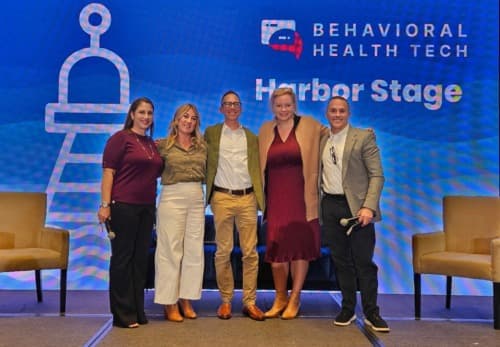
At the 2025 Behavioral Health Tech Conference, Supportiv CEO Helena Plater-Zyberk joined employee benefits leaders and fellow panelists Celeste Parker, David Pawlowski, and Mark Eckstein to discuss how strain on outpatient therapy networks can be reduced despite ever-growing demand.
Panel participants spoke to the value of inter-connectivity and navigation within benefits suites, to the value of looking beyond therapy as a one-size-fits-all model, and to the kinds of intake and triage approaches that can help individuals access the right level of care for their current needs without alienation.
As panelist David Pawlowski put it, paraphrasing Abraham Maslow: “When the only tool you have is a hammer, it’s tempting to look at every problem like a nail.” While therapy is certainly a gold standard, it may be over-prescribed for subclinical struggles like job stress or minor relationship issues. David describes CuraLinc’s focus on “clinically appropriate care – the right level, at the right time, for the right length of time.” The work Celeste Parker describes at Costco, of bringing benefits suppliers together so they may become more interconnected for better routing, fits in a similar vein.
Helena Plater-Zyberk agrees that providing the right level of care, doing care the right way, is important for both care-seekers and strained systems. She contends that while VC-backed companies have spent hundreds of millions on ads for the concept that everyone needs therapy, it’s really not what everyone needs – and that concept is now exacerbating our provider shortage, to boot. She asks: “Are there other ways to solve the massive need, that are more realistic for everyday folks who struggle to even get to outpatient therapy?”
Similarly, David points out that there are situations where coaching, peer support like Supportiv, or even a single-session therapy intervention may be a better fit than therapy. The question of how to make that determination turns the discussion toward assessments.
Helena contends that feeding people assessments has the noble goal of triaging people to the right level of care, but the consumer has evolved beyond that. For better or for worse, assessments cause many consumers to shrink away from care. That may take away from the important sense of psychological safety that Mark Eckstein speaks about.
She shares that, for that reason, Supportiv’s model attempts to break down the assessment barrier, allowing people to say their needs in their own words, and immediately receive a level of care that may even suffice for their needs. If it’s determined another form of care may be more appropriate, the user is referred on to that care in a conversational way – it could be thought of as a “smart” triage system, routing folks to the care they need, in a way that’s both more consumer friendly and less taxing on overburdened clinical networks.
Another aspect of network burden is that most expressed needs must be funneled into and served within business hours. The reality is that this harms care-seekers, too. Needs arise after hours – it’s the human condition. However, clinical providers are unlikely to shift their schedules en masse to reflect this reality. While some folks believe AI will solve this problem, that question has almost become a political divide, says Helena. “Do we value the human connection or not?”
For those who do, her contention is that the future holds a movement beyond the past era of 24 hour staffed call centers, toward a “broad spectrum of para-professional care that can bend the cost curve” in addition to serving needs when they arise and diffusing floods of demand during business hours.
As came up throughout the discussion, Supportiv sits at the intersection of these considerations for reducing network strain, by:
- Welcoming individuals without sometimes-alienating intake assessments (while still capturing relevant data via sentiment modeling, etc.)
- Serving individuals whose needs may not require therapy, or for which therapy may not be conducive
- Offering instant human connection, 24/7/365
- Routing individuals, using an efficient human-AI combination, to the other resources (e.g. from an employer’s benefit suite) that fit them best
For more information on how Supportiv’s approach can help relieve pressure on outpatient therapy networks, feel free to reach out at info@supportiv.com.